
Syntax:
#option bootloader addressExplanation:
#option bootloader prevents the overwriting of any pre-loaded bootloader code, vectors, etc. below the specified address. The GCBASIC code will
start at the specified address.
A bootloader is a program that stays in the microcontroller and communicates with the PC, typically through a serial interface. The bootloader receives a user program from the PC and writes it to the flash memory, then launches this program for execution. Bootloaders can only be used with microcontrollers that can write to their flash memory through software.
The bootloader itself must be written into the flash memory with an external programmer.
In order for the bootloader to be launched after each reset, a goto bootloader instruction must exist somewhere in the first 4 instructions. There are two types of bootloaders: some that require the user
to reallocate the code, and others that themselves reallocate the first 4 instructions of the user program to another location
and execute them when the bootloader exits.
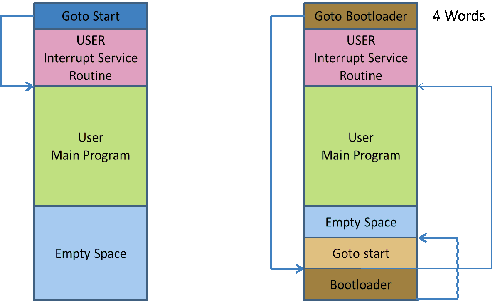
The diagram below shows the architecture of a bootloader. The left-hand side shows the operation of the instructions without a bootloader. The right-hand side shows the initial instruction jumping to the bootloader, then, once the bootloader has initialised, execution of the start code.
See example bootload software.
Example:
#option bootloader 0x800
See Also:
- #Option NoConfig — another option commonly used alongside a bootloader
